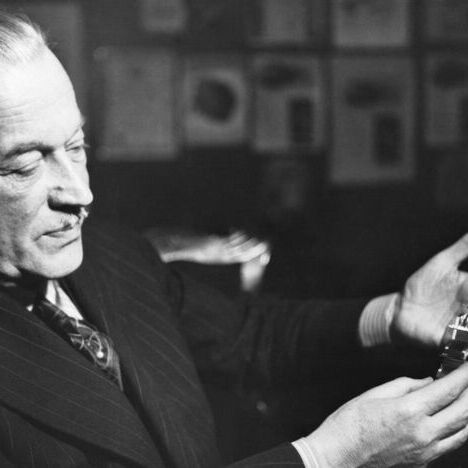
A fine example is Alfred Nobel, the inventor of dynamite: very introverted, very shy, completely absorbed in his own world – his 355 patents made him so wealthy that he was able to endow the Nobel Prize, ‘for the greatest benefit to humankind’.
Can introverts also be rebellious, even though they don’t appear outspoken on the surface?
Absolutely. They are less influenced by the mainstream, are significantly less susceptible to peer pressure and are therefore autonomous in the original sense of the word – that is, ‘a law unto themselves’. I’m thinking of the famous experiment by the psychologist Solomon Asch: test subjects were shown a picture of a line. They were then asked to select, from a choice of three lines of different lengths, the one that was the same length. As long as they had to solve the task on their own, they managed it well. However, when they had to make the choice in a group where all the other participants were deliberately giving the wrong answer, the majority of the test subjects also gave the wrong answer. It is likely that peer pressure even altered their actual perception. This shows that ‘swarm intelligence’ does not arise all that often. Introverts are often more immune to this peer pressure because they tend to avoid groups and prefer to stick to their own thoughts.
Could one say that both of your books deal with the question of how to stay true to oneself in a world of constant expectations and overstimulation?
Exactly. Essentially, it’s about how to reconnect with yourself in a world that constantly distracts you. I believe that’s the main problem of our time: we’re always distracted. The solution is to spend more time on your own – not all the time, but now and then – and to step away from the constant scrolling. Often you think, ‘Now I finally have some time to myself,’ and then reach for your smartphone the very next moment. Mentally, you’re back in the outside world again. In the long run, this pattern isn’t good for us.